March 20, 2021
Does Evolution have a mind of its own? Does it decide?

March 26, 2019
The Image of the Beast that Will Come to Life (Revelation 13)
And he had power to give life unto the image of the beast, that the image of the beast should both speak, and cause that as many as would not worship the image of the beast should be killed. (Rev 13:15)One advantage of prophecy is that it can be verified in history. While the Genesis account of creation is disputed by many in the scientific community (with some theologians attempting to demythologize it), prophecy resists such attempts. Thus, the strongest of evidences for the Messiahship of Jesus did not come from science [it could not] nor from the miracles He did, but from the fulfillment of Old Testament prophecies regarding Him. However, the sheer irony of all this is that while prophecy helps to unfold the meaning of events to the believer, the prophecy itself includes a clause regarding disbelief in the same (which also needs to be fulfilled). Thus, while many disciples were able to see the Messianic prophecies as fulfilled in Jesus, there were many others who could not see this, thus fulfilling the prophecy (though volitionally rejecting it) that they would despise and reject the Messiah.
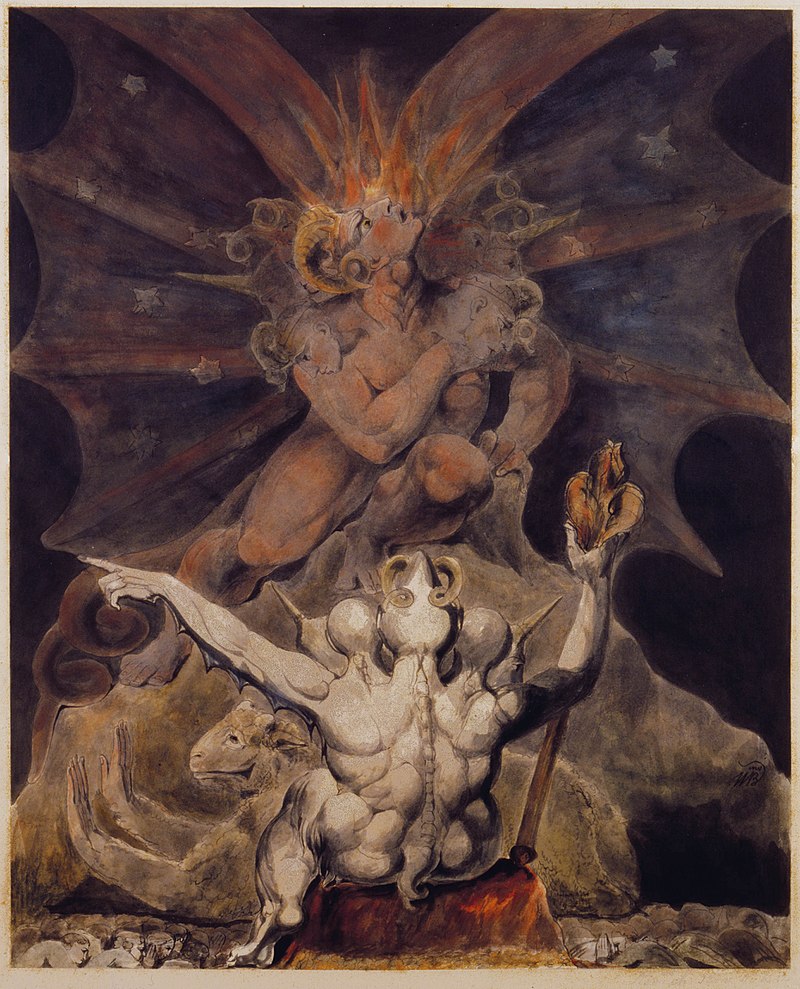
The biggest problem of evolutionism is the issue of how life can originate from a mere collocation of atoms, even if those atoms were (by chance) placed in the right sequence. The either-DNA-or-protein-first problem continues to haunt evolutionists though there are hypotheses that this is resolved by the RNA world hypothesis. Yet, that hypothesis is also not problem-free. It seems that a phenomenon of some kind of genius giving "life unto the image" can be a staggering event for humanity. To the intellectuals, it could suggest a very advanced level of scientific achievement that an image (a rightly sequenced pattern) could not only come to life but also be able to communicate and make intelligent decisions. Probably, this would not be at a level of the much theorized battery powered AI robots (breath of life is not the same as battery-run).
Yet, this would only lead more to the worship of the beast, rather than worship of the living God. No wonder, elevation of the beast, as having originated from the beast, is characteristic of idolatrous worship.
Rom 1:23 And changed the glory of the uncorruptible God into an image made like to corruptible man, and to birds, and fourfooted beasts, and creeping things.The idea of "beast" being used for humans is a reduction that signifies a corruption of the divine image. Without God in the picture, man is not much different from the beasts
Rom 1:25 Who changed the truth of God into a lie, and worshipped and served the creature more than the Creator, who is blessed for ever. Amen.
I said in mine heart concerning the estate of the sons of men, that God might manifest them, and that they might see that they themselves are beasts. For that which befalleth the sons of men befalleth beasts; even one thing befalleth them: as the one dieth, so dieth the other; yea, they have all one breath; so that a man hath no preeminence above a beast: for all is vanity. All go unto one place; all are of the dust, and all turn to dust again. Who knoweth the spirit of man that goeth upward, and the spirit of the beast that goeth downward to the earth? (Ecc 3:18-21, emphatics mine)
But, the forthcoming beast-worshiper will be morally dissolute as well.
Rom 1:24 Wherefore God also gave them up to uncleanness through the lusts of their own hearts, to dishonour their own bodies between themselves:
Rom 1:26 For this cause God gave them up unto vile affections: for even their women did change the natural use into that which is against nature:
Rom 1:27 And likewise also the men, leaving the natural use of the woman, burned in their lust one toward another; men with men working that which is unseemly, and receiving in themselves that recompence of their error which was meet.
Rom 1:28 And even as they did not like to retain God in their knowledge, God gave them over to a reprobate mind, to do those things which are not convenient;
Rom 1:29 Being filled with all unrighteousness, fornication, wickedness, covetousness, maliciousness; full of envy, murder, debate, deceit, malignity; whisperers,
Rom 1:30 Backbiters, haters of God, despiteful, proud, boasters, inventors of evil things, disobedient to parents,
Rom 1:31 Without understanding, covenantbreakers, without natural affection, implacable, unmerciful:
Rom 1:32 Who knowing the judgment of God, that they which commit such things are worthy of death, not only do the same, but have pleasure in them that do them.
Rev 16:9 And men were scorched with great heat, and blasphemed the name of God, which hath power over these plagues: and they repented not to give him glory.
Rev 16:10 And the fifth angel poured out his vial upon the seat of the beast; and his kingdom was full of darkness; and they gnawed their tongues for pain,
Rev 16:11 And blasphemed the God of heaven because of their pains and their sores, and repented not of their deeds.
Rev 16:12 And the sixth angel poured out his vial upon the great river Euphrates; and the water thereof was dried up, that the way of the kings of the east might be prepared.
Rev 16:13 And I saw three unclean spirits like frogs come out of the mouth of the dragon, and out of the mouth of the beast, and out of the mouth of the false prophet.
Rev 16:14 For they are the spirits of devils, working miracles, which go forth unto the kings of the earth and of the whole world, to gather them to the battle of that great day of God Almighty.
August 02, 2018
Creationism, Compatible Theories Issues
Take, for instance, the account of the miracle of water into wine in John 2. There are at least three approaches to this:
The believer: He believes the miracle happened..
The agnostic: He doesn't know if a miracle happened and would like to know more.
The non-believer: He believes miracles are metaphysically impossible.
When it comes to the story of creation , there is not even the option of comparing a previous record of water in the pots vs later record of wine. It's like one only has the wine at hand to investigate if it was changed into wine from water a few moments ago, and no record or evidences beyond that. In such case, a naturalist will only attempt to find ways in which the wine came into existence. That is what the evolutionists are doing. Progressive creationists are a problematic intrusion in that they claim to believe in miracles but are unwilling to accept that the water was made wine just a few moments ago. So, they accept all the possible explanations of the naturalist interposing Jesus where the naturalist theory suffers lack of explanations. Eventually, the newer explanations will push away the supernatural element.
The problem with trying to explain away divine acts (such as creation and miracles) as compatible with scientific theories is that, eventually, one will make way for the theory. In Francis Schaeffer's words, the lower storey eats up the upper storey.
September 07, 2017
Should the Genesis Account of Creation Be Taken Literally Or Figuratively?

Ever since the dawn of Darwinism and the subsequent rise of Evolutionism, theologians have tried to wrestle with objections posed by science to the Creation account. The enormous amount of fossil records and proven accuracy of dating methods that try to figure out dates of each fossil along with other scientific researches are seen as a real issue that intellectual Christianity cannot be blind to. Many of the modern theologians and apologists have given in to some form of accommodation of evolutionary thinking, though trying to keep God in picture as the Prime Cause of all things. Most of them prefer a mythical or figurative interpretation of the Genesis account.
The Catholic Church doesn't ignore the possibility of biological evolution; however, it makes it clear that the theory of biological evolution cannot explain the creation of the human spirit that distinguishes humans from beasts. In his Message to the Pontifical Academy of Sciences on Oct 22, 1996, Pope John Paul II said:
...the theories of evolution which, because of the philosophies which inspire them, regard the spirit either as emerging from the forces of living matter, or as a simple epiphenomenon of that matter, are incompatible with the truth about man. They are therefore unable to serve as the basis for the dignity of the human person.
Catholic.com explains the position:
Concerning biological evolution, the Church does not have an official position on whether various life forms developed over the course of time. However, it says that, if they did develop, then they did so under the impetus and guidance of God, and their ultimate creation must be ascribed to him.
Concerning human evolution, the Church has a more definite teaching. It allows for the possibility that man’s body developed from previous biological forms, under God’s guidance, but it insists on the special creation of his soul.
British New Testament scholar, N. T. Wright, has no interest in the literal interpretation of either Genesis 1-2 or a literal historical Adam. In his Surprise by Scripture (2014), he writes:
...just as God chose Israel from the rest of humankind for a special, strange, demanding vocation, so perhaps what Genesis is telling us is that God chose one pair from the rest of early hominids for a special, strange, demanding vocation. This pair (call them Adam and Eve if you like) were to be the representatives of the whole human race, the ones in whom God's purpose to make the whole world a place of delight and joy and order, eventually colonizing the whole creation, was to be taken forward.
Notable apologist William Lane Craig opts for Progressive Creationism. In his words:
It seems to me that so-called progressive creationism would provide a nice model that would fit both the scientific evidence as well as the biblical data. Progressive creationism suggests that God intervenes periodically to bring about miraculously new forms of life and then allows evolutionary change to take place with respect to those life forms. As for grand evolutionary change, this would not take place by the mechanisms of genetic mutation and natural selection if undirected by God. Rather, we would need miraculous creationist acts of God to intervene in the process of biological evolution to bring about grand evolutionary change. So we would have a kind of progressive creationism whereby God creates biological complexity over time.
...some sort of a progressive creationist view, I think, would explain the evidence quite well. It would allow you to affirm or deny if you wish the thesis of common ancestry and it would supplement the mechanisms of genetic mutation and natural selection with divine intervention. I find some sort of progressive creationism to be an attractive view.
However, Craig is not dogmatic on this stance which he qualifies by saying, "I want to reiterate that on these issues I am like many of you a scientific layperson.... So these opinions are held tentatively and lightly and are subject to revision."
Irish theologian Alister McGrath also favors the non-literal interpretation, not just because of the scientific challenge but because he finds that the literal interpretation was not so popular in early church history. He finds, especially, Augustine's view quite liberating:
What I noticed in the earlier period of the Christian church is that people didn’t read Genesis in that way. I think we have more freedom about how we interpret these passages than some might think. There is no doubt [the Scriptures] teach God made all things. I don’t think they necessarily teach that God made all things instantaneously at one moment in time so that what we now see is the way things always have been. I think it’s more complex than that. Augustine of Hippo gives us a useful theological framework, which means we can begin to engage questions of evolution. You can’t simply say, “It’s the Bible or evolution.” Certainly, I would challenge certain interpretations of evolution—above all, Richard Dawkins’ idea, which is atheistic. I think we need to understand both evolution and Scripture rightly. (An Interview With Alister McGrath, DTS, Dec 2012)
Unsurprisingly, Augustine approaches the text with the culturally prevalent presupposition of the fixity of species and finds nothing in it to challenge his thinking on this point. Yet the ways in which he critiques contemporary authorities and his own experience suggest that, on this point at least, he would be open to correction in light of prevailing scientific opinion. ("Augustine's Origin of Species," CT, May 2009)
My Responses
The literal view of Genesis 1 and 2 may look quite embarrassing to theologians who wish to be or appear intellectually honest in face of surmounting scientific evidences that seem to favor anything but the literal biblical account of creation in Genesis. Some would better prefer to look at the two accounts as more poetic or figurative rather than factual narratives. Of course, the way the narrative is given does not give any hint of it being just a clever poem or illustrative myth.I think the message of the cross is more foolish and scientifically impossible to the secular intellectual mind than the literal take of Genesis 1 and 2. What scientific mind can find the message of a Man (God Incarnate) being crucified for religious and political reasons on the cross as being the Sacrificial Atonement for the sins of all mankind?
For the message of the cross is foolishness to those who are perishing, but to us who are being saved it is the power of God. (1Co 1:18)
...we preach Christ crucified, to the Jews a stumbling block and to the Greeks foolishness, (1Co 1:23)
But, the scientific understanding based on whatever dating technology (as accurate as these may be), and other discoveries, is not "necessarily" conclusive, given its inductive nature and the open possibilities of exceptions. We may laugh at Young Earth Creationists for trying to find evidences for a young earth, but do we know what we are actually doing by questioning the literal historicity of the Genesis account? You cannot sit on the outward end of a branch that you are actually sawing off.
We come to the question of Authority now. The enamor with intellectualism is somehow tied up with universities, professor quotes, appeal to authority fallacies, and various other forms of "authorities" that seem to stand against the authority of Scripture. It is not surprising that such enamor may lead to either seminaries becoming engulfed by universities (through affiliation or absorption) or becoming emptied by universities because they cannot any more retain students who they have educated to favor the universities. But, when it comes to intellectual honesty with faith, I do not think it is really honest to favor some parts of scripture as literal and others as probably figurative based on contemporary scientific understandings on the same theme. If you allow the camel to put his feet inside the tent, obviously, he is going to kick you out of the tent before dawn.
The literal interpretation of Genesis 1 and 2 may look foolish and dumb to many. To many it does not. It makes better sense than the all the various theories of evolution put together. And the latter are certainly not unintelligent and dumb believers. They find it more consistent to believe in Scripture as inerrant and absolutely authoritative for all deductive interpretation and understanding of faith than allow the unstable darts of human wisdom to trouble them with ideas that are perpetually in a flux.
1. If Scriptural inerrancy is superfluous, then biblical faith has lost its basis. The same Scripture that gives an account of creation in six days states the event as the historical basis for the law of the sabbath or rest for the Israelites:
For in six days the LORD made the heavens and the earth, the sea, and all that is in them, and rested the seventh day. Therefore the LORD blessed the Sabbath day and hallowed it. (Exo 20:11)2. If it is scientifically unacceptable that God created Adam out of the dust literally, it should also be scientifically unacceptable that God incarnated as Man in Jesus.
The first man was of the earth, made of dust; the second Man is the Lord from heaven. (1Co 15:47)3. If Genesis 1-2 is taken figuratively only, it would follow that most of the book, if not at least till Genesis 11, cannot be taken literally anymore.
4. The non-literal view challenges the New Testament Gospel of Christ as our Saviour:
For as in Adam all die, even so in Christ all shall be made alive. (1Co 15:22)5. If the authority of Scriptures is subjected to the authority of "science" or intellectual elitism, God becomes subject to the imagination and formulations of the human mind; in short, idolatry.
For if by the one man's offense death reigned through the one, much more those who receive abundance of grace and of the gift of righteousness will reign in life through the One, Jesus Christ.) Therefore, as through one man's offense judgment came to all men, resulting in condemnation, even so through one Man's righteous act the free gift came to all men, resulting in justification of life. For as by one man's disobedience many were made sinners, so also by one Man's obedience many will be made righteous. (Rom 5:17-19)
6. Jesus didn't talk of the Genesis account as merely figurative but as historical and foundational to human values:
"But from the beginning of the creation, God`made them male and female.' 'For this reason a man shall leave his father and mother and be joined to his wife,and the two shall become one flesh'; so then they are no longer two, but one flesh.' "Therefore what God has joined together, let not man separate." (Mar 10:6-9)
See Also
Evolutionism & Living Reality
Problems of Evolutionism
A. E. Wildersmith - Media Library on Science & Bible
Australopithecus Deyiremeda: Strong Argument for Evolutionism?
Chesterton on Darwin's Missing Link
On Church and On Evolution - G K Chesterton
Creation & Evolution
The Anthropic Principle and Epistemic Issues
June 03, 2015
Australopithecus Deyiremeda: Strong Argument for Evolutionism?


Australopithecus deyiremeda is a proposed species of early hominin among those who lived about 3.3–3.5 million years ago in northern Ethiopia, around the same time and place as several discovered specimens of Australopithecus afarensis, including the well-known "Lucy", a juvenile specimen. (Wikipedia). Some 3 jawbones discovered on March 4, 2011 were proposed as specimens of this proposed species. While the discovery may have prompted overjoy in the evolutionist camp, it doesn't aid to quell doubts regarding the problem of transitional fossils (missing links), considered one big problem of the theory of evolution. Of course, while now and then specimen of so-called inter-species are claimed to have been unearthed, the question of why so less of these still lingers. Often, the missing links are either just a few pieces of fragmentary bones that are put together or only jawbones or such. One answer suggested is that the fossil record itself is meagre. But, obviously one can't sell his everything for not-very-conclusive proofs of treasure in the ground; it will require too much faith to hang the theory of evolution on just a few pieces of bones vaguely assumed as some links between notable species. Also, given the fact that the discoveries can be explained in any other way than referring to the evolutionary theories, these fossil facts do not in any way lend bulwark to evolutionism.Of course, there are arguments that there are other "proofs" besides. The creationists have always maintained that evolutionism violates the 2nd Law of Thermodynamics; to which the evolutionists have responded saying that living organisms belong to an open system and not a closed system; therefore, the 2nd Law doesn't apply to them: they receive energy from the sun. But, how does that answer the question of how life evolved out of mere atoms in the first place; for certainty, the atoms weren't above the 2nd Law. Yet, even if it was insisted that energy in the form of say lightning or sunlight aided the random collocation of atoms to form amino acids, proteins, and living bodies, the very idea of randomness makes disorder or chaos inherent to the process, thus self-defeating the theory of evolution that projects an anti-chaotic world, evolving upward. The resorting to feelings of "scientific sincerity" will not be bad only if "scientific sincerity" were for a moment freed from the shackles of "anti-supernaturalism". The excuse that "science is still young" or "fossil records are scant" is just an excuse that is willingly believed in hope of more proofs later on. But, is it scientific to build scientific theories on mere hopes rather than on mathematically accurate calculations and predictions? Of course, one doesn't need to be evolutionist to be scientific; that is clear.
February 14, 2012
Chesterton on Darwin's Missing Link
Sometimes the professor with his bone becomes almost as dangerous as a dog with his bone. And the dog at least does not deduce a theory from it, proving that mankind is going to the dogs-or that it came from them. For instance, I have pointed out the difficulty of keeping a monkey and watching it evolve into a man. Experimental evidence of such an evolution being impossible, the professor is not content to say (as most of us would be ready to say) that such an evolution is likely enough anyhow. He produces his little bone, or little collection of bones, and deduces the most marvelous things from it. He found in Java a piece of a skull, seeming by its contour to be smaller than the human. Somewhere near it he found an upright thigh-bone and in the same scattered fashion some teeth that were not human. If they all form part of one creature, which is doubtful, our conception of the creature would be almost equally doubtful. But the effect on popular science was to produce a complete and even complex figure, finished down to the last details of hair and habits. He was given a name as if he were an ordinary historical character. People talked of Pithecanthropus as of Pitt or Fox or Napoleon. Popular histories published portraits of 'him like the portraits of Charles the First and George the Fourth. A detailed drawing was reproduced, carefully shaded, to show that the very hairs of his head were all numbered. No uninformed person looking at its carefully lined face and wistful eyes would imagine for a moment that this was the portrait of a thigh bone; or of a few teeth and a fragment of a cranium. In the same way people talked about him as if he were an individual whose influence and character were familiar to us all. I have just read a story in a magazine about Java and how modern white inhabitants of that island are prevailed on to misbehave themselves by the personal influence of poor old Pithecanthropus. That the modern inhabitants of Java misbehave themselves I can very readily believe; but I do not imagine that they need any encouragement from the discovery of a few highly doubtful bones. Anyhow, those bones are far too few and fragmentary and dubious to fill up the whole of the vast void that does in reason and in reality lie between man and his bestial ancestors, if they were his ancestors. On the assumption of that evolutionary connection (a connection which I am not in the least concerned to deny), the really arresting and remarkable fact is the comparative absence of any such remains recording that connection at that point. The sincerity of Darwin really admitted this; and that is how we came to use such a term as the Missing Link. But the dogmatism of Darwinian has been too strong for agnosticism of Darwin; and men have fallen into turning this entirely negative term into a positive image. They talk of searching for the habits and habitat of the Missing Link; as if one were to talk of being on friendly terms with the gap in a narrative or the hole in an argument, of taking a walk with a nonsequitur or dining with an undistributed middle. In this sketch, therefore, of man in his relation to certain religious and historical problems, I shall waste no further space on these speculations on the nature of man before he became man. His body may have been evolved from the brutes; but we know nothing of any such transition that throws the smallest light upon his soul as it has shown itself in history.
Unfortunately the same school of writers pursue the same style of reasoning when they come to the first real evidence about the first real men. Strictly speaking of course we know nothing about prehistoric man, for the simple reason that he was prehistoric. The history of the prehistoric man is a very obvious contradiction in terms. It is the sort of unreason in which only rationalists are allowed to indulge. If a parson had casually observed that the Flood was antediluvian, it is possible that be might be a little chaffed about his logic. If a bishop were to say that Adam was Pre-Adamite, we might think it a little odd. But we are not supposed to notice such verbal trifles when skeptical historians talk of the part of history that is prehistoric. The truth is that they are using the terms historic and prehistoric without any clear test or definition in their minds. What they mean is that there are traces of human lives before the beginning of human stories; and in that sense we do at least know that humanity was before history.
February 12, 2012
Problems of Evolutionism
The Problem of Truth As An Absolute Category (Ravi Zacharias)
Ravi: Do you believe that Time, Matter, and Chance created your brain?....
Scientist: Yes.
Ravi: If Time, Matter, and Chance created the human brain, then Truth as an absolute category cannot exist. For, in order for something to be true, it must be true on Sunday, on Monday... But, with the constant flux and fluctuation of Time, Matter, and Chance, all changing, Truth as an absolute category cannot exist.
Scientist: I believe that's right.
Ravi: But, if Truth as an absolute category doesn't exist, then how do you know that it is true that Time, Matter, and Chance created your brain?
____
If Randomness (Chance) and not Intelligence (God) produced the universe, then Truth could not absolute, since "knowledge" whatever it is would be the product of a random collocation of atoms constantly in flux; and, flux being the underlying principle of evolutionism, absolutes become meaningless. But, if Truth doesn't exist, then one doesn't even have the right to say that something is absolutely truth, e.g. evolutionism. Therefore, evolutionism is self-defeating.
The Problem of Scientific Authenticity
Oxford Dictionary defines Science as "the intellectual and practical activity encompassing the systematic study of the structure and behavior of the physical and natural world through observation and experiment". In order for a theory to be scientific in nature, it must be based on observation and experiment. For example, Newton OBSERVED the apple falling from the tree, then formed the THEORY of gravity, which was proven as (at least instrumentally) true by EXPERIMENT (yet, the theory is not an absolute because it's contrary, Einstein's theory of gravity is quite different, yet experimentally "proven"). Evolutionism is neither based on observation (e.g. of fish evolving into frogs in species evolution) nor experiment.
Someone once noted that there are four great problems of evolutionism:
1. The Second Law of Thermodynamics or the Law of Entropy. This Law states that the usable energy of the universe is decreasing; therefore, degradation and not evolution is the principle underlying the processes of the universe. Development only occurs where intelligence is present. Life and intelligence (including DNA) go together.
2. Missing Links. There isn't any evidence that a species evolved into another. No fossil of an ape-man or a fish-reptile have been found. There are not sufficient reasons to theorize that Neanderthal man, Java man, and Peking man were intermediaries between apes and humans. The Piltdown Man was a hoax (Check these articles Piltdown (wikipedia); Neanderthal (ICR)
3. No Known Mechanism. There is no known mechanism of evolution. It is not known because it cannot be observed, and unless one observes something happening (e.g. evolution actually taking place). See the following video:
4. Growing evidences for a young earth. Evolutionism claims eons of time taken for evolution to take place (e.g. hundreds of monkeys randomly hitting on a computer keyboard produced Shakespeare's The Tempest in eons of time). But, there are growing evidences for a young earth. (See Evidence for a Young Earth; Evidence for a Young Earth from the Ocean and Atmosphere by L. Vardiman, PhD)
The Problem of Ethics
If evolutionism is true, then Justice, Courage, and Temperance are invalidated and moral questions become nonsensical. The moral sense is absurd. The serious consequences of such absurdity has been well portrayed by Steve Turner.Turner's Creed as Quoted by Ravi Zacharias
We believe in Marx, Freud and Darwin
We believe everything is OK
as long as you don't hurt anyone
to the best of your definition of hurt,
and to the best of your knowledge.
We believe in sex before, during, and
after marriage.
We believe in the therapy of sin.
We believe that adultery is fun.
We believe that sodomy’s OK.
We believe that taboos are taboo.
We believe that everything's getting better
despite evidence to the contrary.
The evidence must be investigated
And you can prove anything with evidence.
We believe there's something in horoscopes
UFO's and bent spoons.
Jesus was a good man just like Buddha,
Mohammed, and ourselves.
He was a good moral teacher though we think
His good morals were bad.
We believe that all religions are basically the same-
at least the one that we read was.
They all believe in love and goodness.
They only differ on matters of creation,
sin, heaven, hell, God, and salvation.
We believe that after death comes the Nothing
Because when you ask the dead what happens
they say nothing.
If death is not the end, if the dead have lied, then its
compulsory heaven for all
excepting perhaps
Hitler, Stalin, and Genghis Kahn
We believe in Masters and Johnson
What's selected is average.
What's average is normal.
What's normal is good.
We believe in total disarmament.
We believe there are direct links between warfare and
bloodshed.
Americans should beat their guns into tractors .
And the Russians would be sure to follow.
We believe that man is essentially good.
It's only his behavior that lets him down.
This is the fault of society.
Society is the fault of conditions.
Conditions are the fault of society.
We believe that each man must find the truth that
is right for him.
Reality will adapt accordingly.
The universe will readjust.
History will alter.
We believe that there is no absolute truth
excepting the truth
that there is no absolute truth.
We believe in the rejection of creeds,
And the flowering of individual thought.
If chance be
the Father of all flesh,
disaster is his rainbow in the sky
and when you hear:
State of Emergency!
Sniper Kills Ten!
Troops on Rampage!
Whites go Looting!
Bomb Blasts School!
It is but the sound of man worshipping his maker.
Evolutionism & Living Reality
Evolutionism concerns the problem of the origin and nature of living reality. Evolutionism, in science, refers to the theory that ‘the many complex organisms now existent descended or evolved from relatively fewer and simpler organisms.’[1] The hypothetical nature of evolutionism, despite accruement of evidences in support yet inability to verify in prediction or through experimentation, has led some to label it as being not a scientific theory but a philosophical one.[2]
Supposed evidence for organic evolution comes from comparative anatomy, study of vestigial remains, embryology, blood and fluid tests of animals, examination of fossils, study of geographical distribution, domestication and experimentation, and classification.[3]
The theory of evolution doesn’t simply end at ‘the fewer and simpler organisms’. The ultimate problem is how life itself originated. The religious or purely philosophical answers do not concern scientific metaphysics. However, though evolutionism has been labeled sometimes as religious and sometimes as philosophical, its claim to an empirical scientific methodology, generally allots it a place in physical anthropology. According to Duane T. Gish, the General Theory of Evolution is the ‘theory that all living things have arisen by naturalistic, mechanistic processes from a single primeval cell, which in turn had arisen by similar processes from a dead, inanimate world.’[4]
Critics of evolution theory have pointed out that it fails to meet the criteria of a scientific theory. To Gish, for instance its failure consists in not being observed, not being subject to experimentation, and assuming the form of non-falsifiability.[5] Further, a verifiable prediction on the basis of evolution theory has never been successfully made and verified because an adequate theory to explain the mechanism has never been given. In fact, in order for such a theory to even exist, evolution must be first observed, which has never been the case. Therefore, evolutionism cannot be regarded as science, at least in the sense in which all other scientific theories are concerned. However, as relevant to the subject and science and also philosophy, the fundamental assumptions of evolutionism need to be examined.
Evolutionism assumes that life is material. In other words, life is all about a right arrangement of atoms and molecules. On the basis of this assumption, it is supposed that a mixture of certain gases, energy, and water could have given rise to certain organic substances, like amino acids (the building blocks of proteins, including the all-important enzymes that control the chemical processes of life), and purines and pyrimidines (the building blocks of RNA and DNA).[6]Consequently, the sea would have become a ‘soup’ of prebiological organic compounds which would become conducive to the generation of some kind of a replicator that played a crucial role in the development of cells and the origin of life. What all these substances and replicators are is unknown to science. How all this happened is unknown to science.
However, evolutionists seem to be sure that though they are not sure how this all happened, they are at least sure that it has so happened, although they have never observed it happening. Such kind of an approach seems to be too superstitious to some. But all of this proceeds out of a materialistic outlook that not only looks at the world as a machine but also looks at the organism also as a machine. Life, then, is not some spiritual element within the organism. It is simply the animation or growth caused in a material body due to some programmed materials that chanced to happen at random. The strength of belief in evolutionism despite such uncertainty in providing adequate scientific explanations cannot qualify evolutionism as a philosophy, which seeks not mere speculation but argument and reasoning to establish the absoluteness of truth. Consequently, theories that are based on evolutionism also may be as unreliable as evolutionism since it itself stands on uncertainty.
[1] Milton D. Hunnex, Chronological and Thematic Charts of Philosophies and Philosophers (Grand Rapids: Zondervan Publishing House, 1986), p. 17
[2] Harry Rimmer, The Theory of Evolution and the Facts of Science (Grand Rapids: Wm. B. Eerdmans Publishing Company, 1935), p. 18
[3] Titus, Smith, and Nolan, Living Issues in Philosophy, p. 33
[4] Duane Tolbert Gish, “Creation, Evolution and Public Education,” Philosophy and Contemporary Issues, 4th edn. (eds. John R. Burr & Milton Goldinger;New York: Macmillan Publishing Company, 1984), p. 458
[5] Ibid, p. 459
[6] “Evolution,” Microsoft Encarta Encyclopedia (Microsoft Corporation, 2001)