While the idea seems attractive and naturalistic, it renders all notion of wisdom, human institutions of justice, reward and punishment meaningless. Why bother about government, police, courts if justice is automatic. Therefore, the Nyaya logicians argued for the Moral governor of the universe.
Showing posts with label Thoughts. Show all posts
Showing posts with label Thoughts. Show all posts
September 11, 2021

June 07, 2021
Any Speed Limit in Genesis 1 Act
If light speed has a limit and so does everything else in the universe, was there a limit to the speed things were created in Gen 1?
Ans: The Gen 1 account talks of the creation of light, stars, and the sun quite apart from each other (unless one wishes to read Big Bang into it). If so, the act of creation was not subject to the law of speed limit; in fact so because the act itself created light.
April 20, 2021
Buttress of Belief

The Bible does not encourage blind belief. It provides buttresses of belief varying according to context, some of which include:
- A miraculous sign (e.g. Moses in Egypt; Isaiah..)
- A covenant sign and oath (e.g. Abraham, Lord's Supper)
- A surety or guarantee (e.g. Passover..)
- A particular requested sign (e.g Gideon's fleece)
- A particular factual sign (e.g. Elizabeth to Mary)
- A prophetic word - dream (e.g. Joseph to the prisoners)
- A prophetic word - knowledge (e.g. Jesus to Samaritan woman)
- A prophetic word - foretelling (e.g. Jesus to Peter...)
- A healing, providential, protective, deliverance miracle (e.g. Gospels)
- An angelic sign (e.g. Resurrection)
- A divine stroke (e.g. Uzziah's leprosy, Zachariah's muteness, Miriam's leprosy)
- Prophetic fulfillment (Jewish and Gentile, including the Star of Magi)
- etcc....
Since the nature of the belief is supernatural, the buttress usually is also supernatural.
- A written legal surety - The Bible (Word of God)
- A living personal surety - The Holy Spirit
- An authoritative signature - The Name of Jesus Christ (to make orders and requests in prayer and word of deliverance)
- A testifying community - The Church
Items that must not be considered as buttresses of belief:
- Personal feelings (which are fluctuating)
- Zeitgeist or spirit of the age (which are more of a fad)
- Probabilistic naturalist reasoning (whose final resort is chance and whose counterfactuals are not really factual)
- Speculative philosophy (which is mere speculation that attempts to act as an hypothetical gap-filler)
- etcc
Any of the non-buttresses will be able to try to explain away the true buttresses (A.1-13). The non-buttresses actually constitute unbelief. They are also explicitly skeptical if not absolutely irrational and are unreliable for any reasonable venture.
PHOTO: (from dreamstime.com, google images)
December 23, 2020
The Man and the Message in a Post-Postmodern World
It was the case in the OT that the prophet was the message. His very life (that included his family) bore the burden of the message. That unity somehow gets split in a post-postmodern world of clicks, likes, selfies masquerade.
I sadly reflect on those who are "forced" by the socio-religio-political system to assume a multi-face,- confusing themselves and the world. It is even more saddening when one face that seems to carry the message of inner-outer unity suddenly is revealed to be a mask and the unveiled real beneath it is a thorough mess.
November 10, 2020
Lichtman's Predictions, Benford's Law, and Voter Fraud

Quick reflections:
While some are turning to "prophets" and "prophecies" for some clue or answer (Nostradamus included), other's are turning to science (or quasi-science) and maths. Prof. Lichtman's prediction that Biden would win seems almost to have come true, while some are now turning to Benford's Law for forensic evidence to whether voter fraud has really occurred.
But, how fool-proof are any of these?
- Not all "prophecies" can be 100% true for we see through a dark glass as Apostle Paul said. That also can mean that prophetic consonance cannot be treated as proof.
- Lichtman's prediction assumes a pattern of mass psychology and behavior. But, does it appropriately incorporate factors such as fraud and mediacracy? Needs check.
- Benford's Law proves successful in detecting fraud in several areas; however, experts are skeptical if it applies to election results due to population variances involved. At the same time, application of the mathematical law to human decision-making raises the issue of freewill and determination.
- Some have also turned to answer in the stars (astrology). It seems to them to be quite mathematical and deterministic. But, that raises even more complicated questions as to how historical events can be causally connected with starry movements. [The Magi saw a star and followed it to Bethlehem; but, the star did not cause the birth of Christ - that's the difference].
Ref:
Deckert, Joseph, et al. “Benford's Law and the Detection of Election Fraud.” Political Analysis, vol. 19, no. 3, 2011, pp. 245–268. JSTOR, www.jstor.org/stable/23011436. Accessed 11 Nov. 2020.
October 16, 2019
Shaping a Scientific Sense of Self
SCIENCE
|
SELF
|
Causality (determinant factors)
|
Self-determination (freedom)
|
Essentiality (defining features)
|
Social disguise/identity (façade/front)
|
Objectivity (definite facts)
|
Subjective dispositions (feelings)
|
September 15, 2019
3 Principles of the Kingdom in Mark 4-5
Principle of Invisible Action
Jesus was asleep on a pillow and it felt and looked like he didn't care, but He is in control. Like the seed sown that grows regardless of human feeling or knowledge, the work of the Kingdom is independent of human cognizance.
Sometimes, answer to prayer, miracles don't seem happening. But, what seems to be the case is only a matter of subjective perception. God knows what he is doing.
Principle of Tangible Flow of Power
The physical flow of power through CONTACT is evident in both OT and NT (Moses' rod, Elijah's mantle, Elisha's bones, Disciples' kerchiefs, oil...). Jesus perceived power leave His body. ...
But it was faith that Healed her
Principle of Order, Unity, and Seriousness
God is not a God of confusion.
July 31, 2019
Is Pentecostalism a mystical movement?

While Apollos was at Corinth, Paul took the road through the interior and arrived at Ephesus. There he found some disciples and asked them, “Did you receive the Holy Spirit when you believed?”
They answered, “No, we have not even heard that there is a Holy Spirit.”
So Paul asked, “Then what baptism did you receive?”
“John’s baptism,” they replied.
Paul said, “John’s baptism was a baptism of repentance. He told the people to believe in the one coming after him, that is, in Jesus.”
On hearing this, they were baptized in the name of the Lord Jesus. When Paul placed his hands on them, the Holy Spirit came on them, and they spoke in tongues and prophesied. There were about twelve men in all.
The Pentecostal worldview does not attempt at any demythologization nor cessationalization of the Biblical worldview. Angels, spirits, demons, visions, supernatural signs are as real as cups and chairs and cars. It is quite different from the materialistic view of the universe. It is also opposed to the occultic view of reality that Pentecostalism regards as based on "deceiving spirits and doctrines of demons" (1 Tim.4:1). In fact, any nature-idolizing ideology (even if it were naturalistic materialism) is no less deceptive (cf. C.S. Lewis, Screwtape Letters).
If one begins labeling Pentecostalism as a mystical tradition, then it wouldn't be far from when people begin labeling any spiritual encounter as "mystic" - which is too broad a defining scope for mysticism. Mysticism involves claims of trans-rational subjective experiences of the "ultimate" which are heavily colored by the religious ideology of the experiencer and privileged to him/her alone. In contrast, Pentecostalism does not involve any claim of that sort. In fact, Pentecostal teachers regard human self-attempts towards mystic experience as dangerous and make it important for one to differentiate between hallucinations, demonic deceptions, and real spiritual experience. Regarding the mystic experience, William James had noted as early as 1902 in his Varieties of Religious Experiences:
Nitrous oxide and ether, especially nitrous oxide, when sufficiently diluted with air, stimulate the mystical consciousness in an extraordinary degree. Depth beyond depth of truth seems revealed to the inhaler. This truth fades out, however, or escapes, at the moment of coming to; and if any words remain over in which it seemed to clothe itself, they prove to be the veriest nonsense. Nevertheless, the sense of a profound meaning having been there persists; and I know more than one person who is persuaded that in the nitrous oxide trance we have a genuine metaphysical revelation.There have been further research done on the similarities of LSD and mystic experiences:
- The serotonergic system and mysticism: could LSD and the nondrug-induced mystical experience share common neural mechanisms? Goodman N1. Abstract says: This article describes the effects and actions of LSD, and due to the similarities with the nondrug-induced mystical experience the author proposes that the two could have common modes of action upon the brain.
- LSD and Mystical Experiences by G. Ray Jordan, Jr. Cities varieties of and similarities between mystical experiences and LSD experiences
At this juncture, it is important to make a differentiation between revelation and mysticism. Revelation, as in the case of miracles, visions, dreams is not a human initiative, at least theologically speaking (though lasting effects like the drenched fleece of Gideon warrant the theological standpoint), and so must not be labeled as mystic experience. However, mystic experiences originating in meditation and use of drugs may be easily explained as induced by some psychologically altered state due to stress, anxiety, or chemical imbalance in the body. Hallucinations can easily occur to physically ill, weak, or strained people. The ‘saintliness’ of a person, in addition, must not be taken as the standard of evaluating the genuineness of the experience. As was seen, William James saw that the mystic experience did have positive effects in the lives of the mystics; however, his conclusion was that the striking differences of mystics regarding theology, often out of their allegiance to diverse traditions, lends them no credulity for absolute truth. Their mystic experiences only possess pragmatic value that is ‘relatively in favor of all these things,’ i.e., their traditional religious suppositions. Thus, there are pantheist mystics, monist mystics, and monotheistic mystics all different from each other and proving that mysticism, originally, has no intellectual content. James also points out the existence of diabolical mysticism as witnessed in delusional insanity and paranoia. Thus, mysticism cannot be the source of absolute knowledge regarding either reality or divine reality. At the most, it is subjective, relative, diversified, and perhaps life-changing, yet devoid of genuine knowledge. Therefore, mysticism is unreliable.
July 22, 2019
Approaching Truth
Contrary to the postmodern and deconstructionist skepticism regarding the possibility of encountering truth hermeneutically (which, as has been observed, is self-skeptical as well since deconstructionists need to use the medium of language whose efficiency they doubt), Jesus said "You shall know the truth and the truth shall set you free." This might appear too simplistic an understanding of truth; nevertheless, it's undefeatable. Do the deconstructionists believe that they "know the truth and the truth has set them free"? Is it really the truth that they are believing in?
1. Arundhati Principle. (Arundhatīdarśananyāyaḥ (अरुन्धतीदर्शनन्यायः)) The proximate star (or landmark) principle. Arundhati (Alcor) is the smallest star in the Ursa Major, almost invisible. Someone who knows the star can help his friend see it by first pointing to the brightest star closest to Arundhati. Once the friend is able to see the brightest star, it becomes easier to then point to the fainter Arundhati in its proximity. Similarly, distance from truth can make it difficult for some to see it. But, there are brighter truths that are quite visible to the human mind which can serve as proximate guide to seeing the fainter star. Some of these brighter truths might be as simple as parables and illustrations. We use the Arundhati principle almost every time we try to show directions to a place. "After you reach the cantonment area, you will see a big blue house. The little spices shop is just beside it."
2. Proximation principle. As one draws closer, the object of knowledge becomes more clearer and several previous assumptions regarding it begin to fade away gradually. The truer assumptions gain confirmation. Many questions also get answered. A distant reflection of water may turn out to be a mirage. A distant twinkling of faint light might turn out to be a large town. It is not uncommon for those who are far from God to have many assumptions regarding Him, some even doubting His existence. But, as we draw closer to Him, He draws closer to us. Similarly, as one gains more insights of scriptural truths, several notions get clarified and truth is known through ap-proximation.
1. Arundhati Principle. (Arundhatīdarśananyāyaḥ (अरुन्धतीदर्शनन्यायः)) The proximate star (or landmark) principle. Arundhati (Alcor) is the smallest star in the Ursa Major, almost invisible. Someone who knows the star can help his friend see it by first pointing to the brightest star closest to Arundhati. Once the friend is able to see the brightest star, it becomes easier to then point to the fainter Arundhati in its proximity. Similarly, distance from truth can make it difficult for some to see it. But, there are brighter truths that are quite visible to the human mind which can serve as proximate guide to seeing the fainter star. Some of these brighter truths might be as simple as parables and illustrations. We use the Arundhati principle almost every time we try to show directions to a place. "After you reach the cantonment area, you will see a big blue house. The little spices shop is just beside it."
2. Proximation principle. As one draws closer, the object of knowledge becomes more clearer and several previous assumptions regarding it begin to fade away gradually. The truer assumptions gain confirmation. Many questions also get answered. A distant reflection of water may turn out to be a mirage. A distant twinkling of faint light might turn out to be a large town. It is not uncommon for those who are far from God to have many assumptions regarding Him, some even doubting His existence. But, as we draw closer to Him, He draws closer to us. Similarly, as one gains more insights of scriptural truths, several notions get clarified and truth is known through ap-proximation.
July 15, 2019
Do Religious Conversion themselves have any evidential value?
While the reasons behind religious conversions may be considered for any potential evidential value, the conversions themselves do not possess any intrinsic value apart from their rationale.
Conversions may have various motivations. There might even be a mixture of various motivations behind them. Conversions prompted by lure or coerced by means of fear or force do not possess intrinsic value. Similarly, conversions backed by diplomatic motives are neither real. Real conversions are governed by strong epistemic values of justification.
King Solomon's turning towards the religions of his non-Jewish wives by itself does not constitute an invalidation of his previous privileged claim of a personal visitation of the Lord in which he received the gift of wisdom. It does not prove that the religions that he turned to in his later years were superior or more advanced or similar to his previous faith. Similarly, King Saul's turn to spiritist involvement in the forbidden practice of contacting the dead doesn't establish spiritism in any way as a valid alternative to the prophetical movement. On the other hand, the medium's terror at seeing Samuel demonstrates the superiority of the prophetical movement. When the prophet Balaam refrained from cursing the Israelites and instead blessed them, it may have seemed that he stood in support of them. But, the New Testament reveals that his heart was covetous.
In any claims of conversions, the motives and the rationale behind them must be thoroughly investigated.
One prominent example of conversion is that of Paul. He wasn't swayed in any way by the preaching of the apostles or the testimony of Stephen's vision at his stoning. He was an uncompromising Pharisee and persecutor of Christians until he had a personal encounter with Jesus on the road to Damascus. Following this experience, he underwent several persecutions for the sake of the Gospel. There was no political, social, mainline religious, or economic benefit or advantage from this conversion. The primary rationale behind his conversion was his empirical encounter with Christ on the road to Damascus.
In modern times, we have testimonies of such dramatic conversions in people like Sadhu Sundar Singh (who came to be known as the apostle with bleeding feet), Gulshan Esther, and Karamchand Hans.
But, even as neither the testimonies of the disciples, if Paul had heard them, nor the testimony of Stephen had any evidential value for Paul, such privileged testimonies might not have any evidential value for any other person than the experiencer.
Also, Jesus said that even if a dead were raised and sent to testify, it would not be evidence enough for the Jews who did not take the testimonies of Moses and the prophets seriously. For the Ethiopian Eunuch to whom Philip preached the Gospel, a simple reading of Isaiah and a testimony of Jesus was sufficient evidence for faith.
But, obviously, for Paul, Sundar Singh (who had previously torn and burnt the Bible), and Karamchand (who previously beat his mother for professing faith in Christ) Christian preaching itself was insufficient. They were given a personal physical encounter.
Solomon too had a personal vision. But, he turned away. So, Paul places safeguards when he says: "But though we, or an angel from heaven, preach any other gospel unto you than that which we have preached unto you, let him be accursed." (Gal 1:8)
And, he confesses: "But I discipline my body and keep it under control, lest after preaching to others I myself should be disqualified." (1 Cor.9:27)
Conversions may have various motivations. There might even be a mixture of various motivations behind them. Conversions prompted by lure or coerced by means of fear or force do not possess intrinsic value. Similarly, conversions backed by diplomatic motives are neither real. Real conversions are governed by strong epistemic values of justification.
King Solomon's turning towards the religions of his non-Jewish wives by itself does not constitute an invalidation of his previous privileged claim of a personal visitation of the Lord in which he received the gift of wisdom. It does not prove that the religions that he turned to in his later years were superior or more advanced or similar to his previous faith. Similarly, King Saul's turn to spiritist involvement in the forbidden practice of contacting the dead doesn't establish spiritism in any way as a valid alternative to the prophetical movement. On the other hand, the medium's terror at seeing Samuel demonstrates the superiority of the prophetical movement. When the prophet Balaam refrained from cursing the Israelites and instead blessed them, it may have seemed that he stood in support of them. But, the New Testament reveals that his heart was covetous.
In any claims of conversions, the motives and the rationale behind them must be thoroughly investigated.
One prominent example of conversion is that of Paul. He wasn't swayed in any way by the preaching of the apostles or the testimony of Stephen's vision at his stoning. He was an uncompromising Pharisee and persecutor of Christians until he had a personal encounter with Jesus on the road to Damascus. Following this experience, he underwent several persecutions for the sake of the Gospel. There was no political, social, mainline religious, or economic benefit or advantage from this conversion. The primary rationale behind his conversion was his empirical encounter with Christ on the road to Damascus.
In modern times, we have testimonies of such dramatic conversions in people like Sadhu Sundar Singh (who came to be known as the apostle with bleeding feet), Gulshan Esther, and Karamchand Hans.
But, even as neither the testimonies of the disciples, if Paul had heard them, nor the testimony of Stephen had any evidential value for Paul, such privileged testimonies might not have any evidential value for any other person than the experiencer.
Also, Jesus said that even if a dead were raised and sent to testify, it would not be evidence enough for the Jews who did not take the testimonies of Moses and the prophets seriously. For the Ethiopian Eunuch to whom Philip preached the Gospel, a simple reading of Isaiah and a testimony of Jesus was sufficient evidence for faith.
But, obviously, for Paul, Sundar Singh (who had previously torn and burnt the Bible), and Karamchand (who previously beat his mother for professing faith in Christ) Christian preaching itself was insufficient. They were given a personal physical encounter.
Solomon too had a personal vision. But, he turned away. So, Paul places safeguards when he says: "But though we, or an angel from heaven, preach any other gospel unto you than that which we have preached unto you, let him be accursed." (Gal 1:8)
And, he confesses: "But I discipline my body and keep it under control, lest after preaching to others I myself should be disqualified." (1 Cor.9:27)
March 24, 2019
The Divine Basis of the Great Commandment
The essential Christian ethic is love. The commands such as "Do not murder", "Do not bear false witness", and the like are by virtue of this essential principle.One of them, an expert in the law, tested him with this question: “Teacher, which is the greatest commandment in the Law?” Jesus replied: “‘Love the Lord your God with all your heart and with all your soul and with all your mind.’ This is the first and greatest commandment. And the second is like it: ‘Love your neighbor as yourself.’ All the Law and the Prophets hang on these two commandments.”
Let no debt remain outstanding, except the continuing debt to love one another, for whoever loves others has fulfilled the law. The commandments, “You shall not commit adultery,” “You shall not murder,” “You shall not steal,” “You shall not covet,” and whatever other command there may be, are summed up in this one command: “Love your neighbor as yourself.” Love does no harm to a neighbor. Therefore love is the fulfillment of the law. (Romans 13:8-10)So, while particulars such as "Do not murder", "Do not steal", etc do not apply to God (who is One and there is no other distinct god(s) to kill or steal from), the universal essential principle of love must find its basis in Him; otherwise, it becomes invalid and non-essential. The Scriptures, however, makes it quite obvious that the Triune God is the supreme foundation of the Great Commandment.
While one may not find a big issue in God's exemplification of the second command to love one's neighbor as oneself (Jesus incarnated as flesh and blood and became our Good Samaritan), one can also clearly see in the Scripture that the Triune God exemplifies the first command to "Love the Lord your God with all your heart..."
One may ask, "How can that be possible, since there is no God above God? How can God love God will all His heart...?" The answer is that Jesus did refer to the Father as "My God", as in "My God and My God, why have You forsaken Me?" (Matthew 27:46). Similarly, the Father refers to the Son as God when He says, "Your throne, O God, will last for ever and ever; a scepter of justice will be the scepter of your kingdom." (Hebrews 1:8).
Similar verses that affirm love within the divine community fill the pages of the Gospels.
August 05, 2018
The Cross Poses A Choice
The Cross poses a choice: either we are crucified with Him or are the crucifiers of Him.
They who turn away, crucify Him afresh.
They who are crucified live as crucified.
There is the fact of death, there is the act of death.
As we have been put to death with Him to live by His Spirit, so we are to put to death the deeds of flesh by the Spirit.
Ecclesiastes 12:7- The Spirit
Then shall the dust return to the earth as it was: and the spirit shall return unto God who gave it. Eccl.12:7
All throughout the book, the preacher reminds us that everything is ephemeral, transitory, and vanishing like a vapor. However, towards the end of the book, at the point where he describes how the strong human gets weaker, ultimately falling to the ground, he mentions that there is one part of man that isn't a vapor after all: the spirit of man.
It is certainly foolish to ignore the spirit and focus all attention on things that are intrinsically vaporish and perishing. Jesus asked what would it profit if a man gained the whole world but lost his on soul. Nothing.
Therefore, we are reminded to remember our creator in the days of our youth.
..
August 02, 2018
Creationism, Compatible Theories Issues
Take, for instance, the account of the miracle of water into wine in John 2. There are at least three approaches to this:
The believer: He believes the miracle happened..
The agnostic: He doesn't know if a miracle happened and would like to know more.
The non-believer: He believes miracles are metaphysically impossible.
When it comes to the story of creation , there is not even the option of comparing a previous record of water in the pots vs later record of wine. It's like one only has the wine at hand to investigate if it was changed into wine from water a few moments ago, and no record or evidences beyond that. In such case, a naturalist will only attempt to find ways in which the wine came into existence. That is what the evolutionists are doing. Progressive creationists are a problematic intrusion in that they claim to believe in miracles but are unwilling to accept that the water was made wine just a few moments ago. So, they accept all the possible explanations of the naturalist interposing Jesus where the naturalist theory suffers lack of explanations. Eventually, the newer explanations will push away the supernatural element.
The problem with trying to explain away divine acts (such as creation and miracles) as compatible with scientific theories is that, eventually, one will make way for the theory. In Francis Schaeffer's words, the lower storey eats up the upper storey.
June 11, 2018
On Nominalism
You can only sense something that is there (somewhere, in or out). And, one attempts to name what one senses in order to identify, record, express, and connect. From sensation to idea formation to naming to expressing is an incredible journey. In most cases, existing names are identified and matched with subjective sensations. In most cases, as well, these identifiers get modified to represent and establish newer sense-ideas. Thus, word meanings get enhanced and extended, or may become obsolete or replaced. In other cases, words are imported where there is a lack, and in some cases, created or recreated.
May 16, 2018
3 Kinds of Books
 |
| PC: Wikipedia |
There are a number of kind of books, but most of them can be classified into three: the guide, the advertisement, the thesis.
1. The Guide is purely informative and contains no argument whatsoever. Most descriptive writings, prose and poetry, fall into these. Legal instruction documents (not court arguments) are guides. Also included are manuals and handbooks. Some religious documents are also purely instructional. The "Why" question is neither anticipated nor answered.
2. The Advertisement. These are popular books that contain arguments based on personal or case experiences. They possess narratives in support of ideas. Like popular ads they may bear testimonials of celebrities or experts. These can be highly inspirational.
3. The Thesis. These are academic writings with lot of technical jargon written mainly for the academic audience. Includes research publications, academic articles, and contain technical arguments.
For instance, The Thesis is like work that forms the basis of the manufacture of a new smartphone. The Advertisement is how this phone is introduced to the public. The Guide is the manual that comes along with the phone on purchase.
Obviously, the advertisers play a significant role.
September 02, 2017
Stories
Life is an interweaving of stories. We hear stories all the time and stories help us to experience the experiences of others, though vicariously, though in a personal way feeling together with the other. One of the greatest gifts given to humanity by God is the gift of imagination. It is saddening when this is used vilely and foolishly, but humans need imagination to transcend their own world-frame and enter another world-frame to experience learning and benefit from the experiences of others. Stories cannot be told or listened to without the use of imagination.
Stories can help to shed light on ideas. Jesus used stories to teach great truths in simple terms. The Bible is filled with stories to help us understand God, this world and ourselves better. Stories can be realistic or fantastical. Unrealistic fictions may not always be useful. Educators such as Plato tried to suggest state censorship on stories that could confuse citizens on issues of absolutes, truth, and values.
If it wasn't for stories, we would just be limited to our own experiences. Stories help us to benefit from the experiences of others. A good story actually helps us feel with the characters portrayed in the story and identify with or learn from the tale being told.
There are good stories and there are evil stories. There are also evil-intentioned stories. Slandering, gossiping, and tale bearing are examples of evil-intentioned story-telling.
Stories are entertaining, which means that they can appeal to itchy ears. What one desires for reveals one's nature. The kind of stories that one is amused with reveals the kind of heart that one has. The kind of stories one believes in and likes reveals the kind of faith that one has. Stories can communicate holiness or sin, virtue or vice, happiness or sorrow.
Stories also reveal our inner heart, whether it stands on the side of evil or on the side of good.
Stories can help to shed light on ideas. Jesus used stories to teach great truths in simple terms. The Bible is filled with stories to help us understand God, this world and ourselves better. Stories can be realistic or fantastical. Unrealistic fictions may not always be useful. Educators such as Plato tried to suggest state censorship on stories that could confuse citizens on issues of absolutes, truth, and values.
If it wasn't for stories, we would just be limited to our own experiences. Stories help us to benefit from the experiences of others. A good story actually helps us feel with the characters portrayed in the story and identify with or learn from the tale being told.
There are good stories and there are evil stories. There are also evil-intentioned stories. Slandering, gossiping, and tale bearing are examples of evil-intentioned story-telling.
Stories are entertaining, which means that they can appeal to itchy ears. What one desires for reveals one's nature. The kind of stories that one is amused with reveals the kind of heart that one has. The kind of stories one believes in and likes reveals the kind of faith that one has. Stories can communicate holiness or sin, virtue or vice, happiness or sorrow.
Stories also reveal our inner heart, whether it stands on the side of evil or on the side of good.
Stories can influence worldviews and the way we perceive things. Stories can instill fear or make us courageous.
The Bible instructs us:
The Bible instructs us:
"Have nothing to do with godless myths and old wives' tales; rather, train yourself to be godly." (1Tim.4:7)
July 19, 2017
Were Peter and John Illiterate?
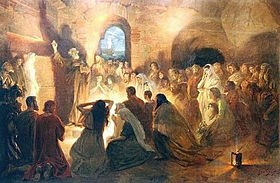 Now when they saw the boldness of Peter and John, and perceived that they were uneducated and untrained men, they marveled. And they realized that they had been with Jesus. (Acts 4:13)
The phrase "uneducated and untrained" can be also rephrased as "not educated in rabbinic law nor professionally trained in matters of religion." But, certainly, it does not mean that Peter and John were illiterate. They were literate enough to write epistles and professionally trained fishermen. However, the scribes and temple leaders didn't recognize them as literate according to their standards and procedures of education. But, they were trained better than the scribes in understanding the law and the prophets and their fulfillment in Christ.
Later on, Peter stresses the importance of a right training for an understanding of the scriptures. He says that there are some who are unlearned and unstable that twist the scriptures.
There are some things in those [epistles of Paul] that are difficult to understand, which the ignorant and unstable twist {and} misconstrue to their own utter destruction, just as [they distort and misinterpret] the rest of the Scriptures. (2Pet. 3:16, Amp)
It is more important to know the grace of Jesus Christ than to memorize 10,000 commentaries on the law. The disciples knew Jesus, and everybody took note that they were with Him.
June 23, 2017
Placebo and the Philosophy of Mind and Matter in Drug Research
A placebo is a non-therapeutic substance administered under the camouflage of medication to deceive patients into believing that they are receiving medications; this done solely for psychological and not for physiological effects. Placebo may usually be used to compare its effects with the effects of other drugs in drug research.
Let's take the case of an experiment that tries to establish whether a particular drug, say to treat weariness, is genuine or merely has the effects of a placebo. Suppose 20 candidates are chosen for this experiment. 10 are given the drug and the rest are put on a placebo while they are told that the placebo is a genuine medication. They need to make sure that the deception is well carried on for the success of the experiment. If both the groups make similar improvements after taking the treatments, the new drug seems to only function as a placebo in effect.
The basic hypothesis of the placebo raises the question of mind over matter. Of course, this pushes the question into the domain of philosophy. If the dualism is strongly affirmed, one implication can also be that sometimes physiologically active drugs may not be effective when hindered by psychological conditions.
But, what is the nature of this "dualism"? Is there a limit of interaction? How far can one push the mind? Is it ethically justifiable to deceive patients to use placebo? How can knowing (even being deceived) affect therapy? What is the nature of faith and its relation to therapy?
Researchers continue to probe these questions.

June 18, 2017
The Light of Law Vs Light of Christ (John 8)
JOHN 8:1-12
Jesus went unto the mount of Olives. And early in the morning he came again into the temple, and all the people came unto him; and he sat down, and taught them. And the scribes and Pharisees brought unto him a woman taken in adultery; and when they had set her in the midst, They say unto him, Master, this woman was taken in adultery, in the very act. Now Moses in the law commanded us, that such should be stoned: but what sayest thou? This they said, tempting him, that they might have to accuse him. But Jesus stooped down, and with his finger wrote on the ground, as though he heard them not. So when they continued asking him, he lifted up himself, and said unto them, He that is without sin among you, let him first cast a stone at her. And again he stooped down, and wrote on the ground. And they which heard it, being convicted by their own conscience, went out one by one, beginning at the eldest, even unto the last: and Jesus was left alone, and the woman standing in the midst. When Jesus had lifted up himself, and saw none but the woman, he said unto her, Woman, where are those thine accusers? hath no man condemned thee? She said, No man, Lord. And Jesus said unto her, Neither do I condemn thee: go, and sin no more. Then spake Jesus again unto them, saying, I am the light of the world: he that followeth me shall not walk in darkness, but shall have the light of life.
CONTRAST TO 1JOHN 1:5-7
This then is the message which we have heard of him, and declare unto you, that God is light, and in him is no darkness at all. If we say that we have fellowship with him, and walk in darkness, we lie, and do not the truth: But if we walk in the light, as he is in the light, we have fellowship one with another, and the blood of Jesus Christ his Son cleanseth us from all sin.

The light of the Law exposes and condemns; the light of Christ covers and cleanses.
The light of the Law casts one's countenance down; the light of Christ lifts up one's countenance.
The light of the Law brings knowledge of sin; the light of Christ brings knowledge of God's salvation.
The light of the Law makes one weak; the light of Christ makes one strong.
The light of the Law brings guilt; the light of Christ brings justification.
The light of the Law is unclear about many things (is "veiled"; they needed many commentators); the light of Christ is open-faced.
The light of the Law is fading; the light of Christ is ever glorious.
The light of the Law is destructive; the light of Christ is transformative.
The light of the Law brings bondage; the light of Christ brings freedom.
The light of the Law brings weariness and tiredness; the light of Christ refreshes one's soul.
The light of the Law brings death; the light of Christ brings life.
Subscribe to:
Posts
(
Atom
)