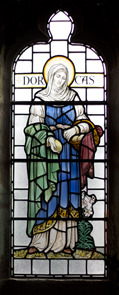
We are not told how old she was, whether she was married, what job or business she did (we are told what Lydia did for a living, but we are not told what Dorcas did), whether she was beautiful, and whether she was rich or poor. Those things don't matter to those within the New Covenant. The most important thing relates to discipleship and one's life and testimony in Christ.
Dorcas may not have been a preacher, a woman with notable signs and wonders following her ministry. She didn't write a book nor was she any entertainer. However, the Bible praises her for the qualities that it finds in her.
1. She was a Disciple (Acts 9:36)
The first distinctive of Dorcas was that she was a believer in Christ and was a sincere follower, a learner, a disciple of Christ. Jesus said that discipleship involves self-denial and cross-bearing. So, Dorcas knew what things needed to be denied in order to follow Christ. Remember Joppa as the same place where Jonah tried to run away from God. But, here was someone who was not known as a prophetess but certainly as a disciple of Christ.
2. She was Full of Good Works (Acts 9:36)
It is one thing to do a few good works, it is quite another thing to be full of good works. Dorcas's life overflowed with good works. The Bible tells us that we are the workmanship of God in Christ created unto good works. These good works were ordained for us from the foundation of the world (Eph.2:10). Thus, you may find situations in your life where there is an opportunity to do a good work that someone else won't have. It might be an elderly person at home that you have been entrusted with. It might be a widow that you know or an orphan boy or girl among your relatives. It might be a husband or a wife that is sick, or even who is off-track but deserves goodness because Christ loved us and gave His life for each one. Sometimes one may have the opportunity to even be a Good Samaritan. Every day presents us with opportunities to do good works. Are we full of them? There is no sense thinking, "I want to do good works" while ignoring and being deaf and blind to opportunities for the same around us that we only need to extend our hand and grab (Tit.3:1).
3. She was Full of Charitable Deeds (Acts 9:36)
She gave a lot. A person may spend for himself or even spend for others. There are some who give gifts to the rich. That is not charity. The Bible says that one who gives gifts to the rich will become poor. Charity is love in action. It is to give away what could use for oneself in order to help the other. It is a shame if you have Lazarus at your gates while you move around in your Mercedes. The Bible anticipates us to be charitable (1Tim.6:18). It tells us that if we close our ears to the cry of the poor, when we cry our cries will not be heard. Joppa might be a port where hundreds of people visited everyday. Most of the time, business would be in the mind of people. However, Dorcas found opportunity to give away and help those in need. Surely, what we invest in people has an eternal reward. But, blessed is the person who gives not in order to receive, but out of love and lovingkindness. The Bible tells us that our gifts of charity and alms reach up to heaven (Acts 10:31). Also, the Bible wants us to be impartial in our charity as the Father above is.
4. She was in Fellowship with the Disciples (Acts 9:38)
We are told that it was the disciples who sent for Peter when they knew he was around. This tells us that Dorcas was associated with the Local Church and community of disciples. They didn't just bury her. Even in her death, she was precious to the family of God.
5. She Made Coats and Clothes for the Widows (Acts 9:39)
She took away time to work with her own hands to do something for the widows. She didn't just say, "I'll give them the cloths, let them make their coats!" Her generosity had an intense touch of love. It was not just the coats but the love woven into those fabrics that couldn't make the widows hold back their tears. The coats were not just a symbol of charity. They were emblems of deep love, and precious time spent for each of the widows. I have a feeling that Peter wasn't called to raise up Dorcas. But, perhaps the tears of the widows compelled compassion. I am reminded of Jesus meeting the widow of Nain and being moved by her tears. How different is this little unknown Tabitha from the well known King Herod! Herod knew that nobody would mourn his death and so ordered that when he died, all the prominent men of the city must be killed so that there would be some mourning around. In those days, they even hired mourners. But, the scene in Acts 9 is totally different. The tears of the widows were not tears of bereavement, but tears that testified of Dorcas' love for them.
Of course, Peter had to remove all the women weeping there, in order to pray. However, we are also told that when Tabitha was raised, he presented her to them and the disciples.
6. She was a Woman of Deep Honor (Acts 9:40)
We are told that as soon as Tabitha opened her eyes and saw Peter, she sat up. Of course, she needed help to stand up. But, her very act of intuitively sitting up reflects the deep respect and honor that was inbuilt in her heart. She had self-honor and she also had respect for an elderly brother and man of God.
Faith, good works, charity, communion, fellowship, love, and honor: how distinctive to find them all in this disciple of Joppa!
But, then we are told that she became sick and died. How could this have happened to a person like her? The Bible doesn't tell us that people of God will not get sick. Even Elisha became sick (2Kgs.13:14). We are certainly told to call the elders to pray for us when we get sick (James 5:14). Nevertheless, a child of God must not see sickness or illness as a misfortune. Nothing in this world, no suffering, can compare with the glory that God has in store for His own. But, then when we stand before Him on the that Final Day, will the Word be able to testify that have been full of Good Works? (1Jn.5:2,3,4,7).

No comments :
Post a Comment